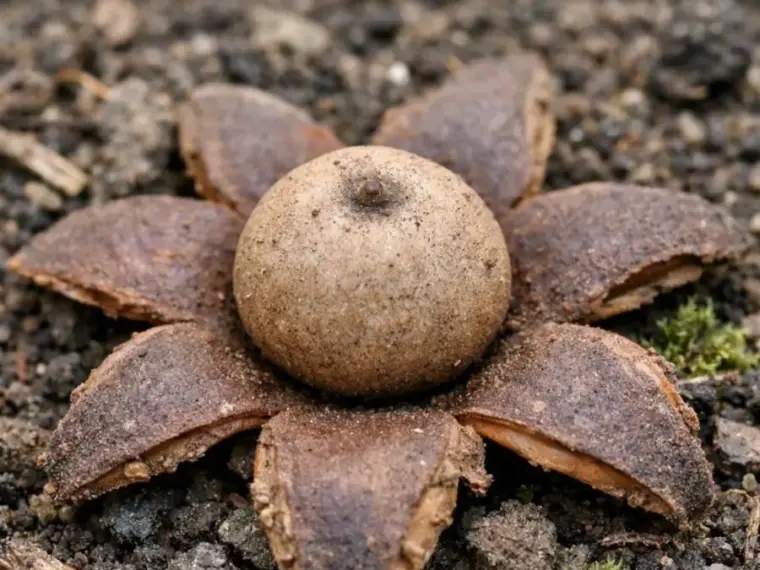
Discovering a strange, star-shaped pod growing in your yard can be both intriguing and confusing. You might have stumbled upon this peculiar formation near your shed and wondered about its origins and purpose. These mysterious structures, which release a puff of dust when disturbed, are not extraterrestrial artifacts, but rather fascinating members of the fungal kingdom known as Earthstars.
Earthstars, with their unique appearance and intriguing behavior, capture the curiosity of anyone who encounters them. While they might seem unusual at first glance, they are a natural part of the ecosystem and offer insights into the hidden world beneath our feet. This article will explore what these star-shaped pods are, how they grow, their ecological role, and whether they pose any risks to humans or pets.
1. Meet the Earthstar: The Strange Star-Shaped Pod in Your Yard
The star-shaped pod you found is likely an Earthstar, a type of fungi belonging to the Geastrum genus. Earthstars are a type of puffball fungus, characterized by their unique star-like appearance. When mature, the outer layer of the Earthstar splits open to form a star-shaped pattern, which can range from 5 to 15 centimeters in diameter.
These fungi are saprotrophic, meaning they feed on decaying organic matter, which is why they often appear in rich, organic soils. Earthstars are not just fascinating for their shape, but also for their role in nutrient cycling within the ecosystem. By breaking down organic matter, they help recycle nutrients back into the soil, supporting plant growth and maintaining soil health.
2. How Earthstar Mushrooms Grow and Why They Look So Alien
Earthstars begin their life cycle as small, round, and unassuming structures hidden within the soil. As they mature, the outer layer of the fruiting body splits open in a star-like fashion, revealing the central spore sac. This transformation from a simple sphere to a multi-pointed star is what gives the Earthstar its alien appearance.
The development of the Earthstar is highly dependent on environmental conditions such as moisture, temperature, and soil composition. Typically, they emerge during the fall when the conditions are just right. The star-shaped rays help elevate the central spore sac above the ground, making it easier for wind or physical disturbance to disperse the spores.
3. The Puff of “Dust”: What’s Really Happening When You Poke the Center
The puff of dust released when you poke the center of an Earthstar is actually a cloud of spores. These spores are the fungus’s means of reproduction, and their release is triggered by physical disturbance or raindrops striking the spore sac.
Each Earthstar can produce millions of tiny spores, which are carried by the wind to new locations where they can germinate and form new fungal colonies. This spore dispersal mechanism is a common strategy among fungi, enabling them to colonize new areas and maintain their populations.
4. Key Features to Identify an Earthstar Versus Other Puffball Fungi
Earthstars can be distinguished from other puffball fungi by their characteristic star-shaped appearance. While other puffballs remain globular throughout their life cycle, Earthstars open up to reveal their star-like rays. The central spore sac is also a distinguishing feature, as it sits atop the rays.
Additionally, the texture and color of Earthstars can help in their identification. The rays are typically tough and leathery, and their color can range from whitish to brown, depending on the species and the age of the fungus.
5. Where Earthstars Typically Grow and Why They Show Up Near Sheds
Earthstars often grow in areas with rich, organic soil, which can be found near decaying wood, leaf litter, or compost piles. This makes the area near a shed an ideal habitat, especially if there is organic debris or mulch present.
They are also found in forested areas, grasslands, and even urban environments, showcasing their adaptability to different soil types and environmental conditions. The presence of Earthstars near your shed could indicate a healthy, decomposing organic layer that supports a robust microbial community.
6. Are Earthstar Mushrooms Dangerous to People or Pets?
Earthstars are generally not considered dangerous to humans or pets. They are not toxic, but they are also not edible due to their tough and fibrous texture. Ingesting large quantities of spores might cause mild irritation, but this is unlikely to occur under normal circumstances.
As always, it is advisable to handle any unfamiliar fungi with caution, particularly if you have pets or young children who might be curious enough to taste them. Proper hygiene, such as washing hands after handling fungi, is recommended.
7. Should You Remove Earthstars or Let Them Be?
Whether to remove Earthstars or leave them in place depends largely on personal preference. If they are not causing any harm and you appreciate their presence, you might choose to let them be as they contribute to the ecological health of your garden.
However, if you prefer a tidy garden or if the Earthstars are growing in inconvenient locations, you can choose to remove them. Remember that they play a role in nutrient cycling, so their presence is beneficial to soil health.